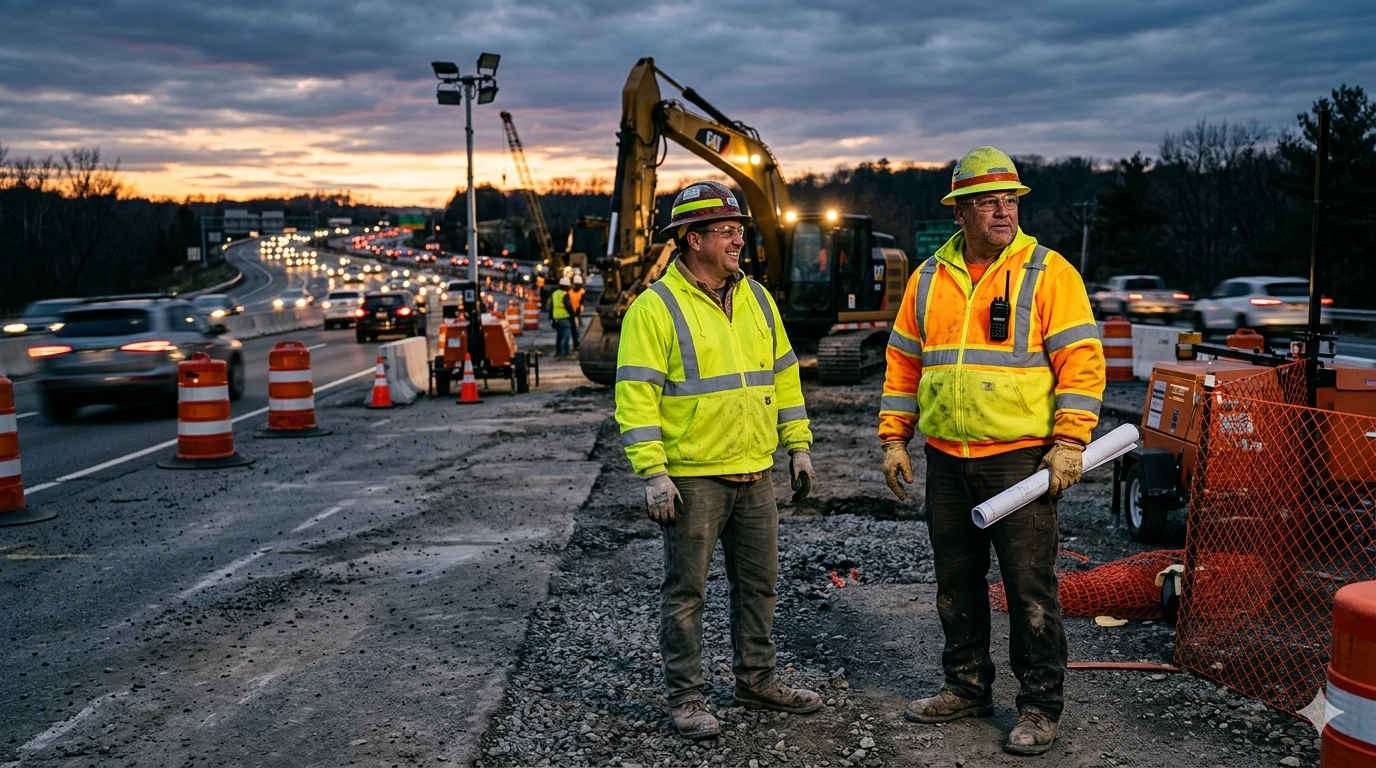
Whether your crew needs hi vis Class 2 vs 3 jackets is a question every foreman has bumped into, and the answer is not always intuitive. The two ratings differ in reflective material area, sleeve coverage, and the kinds of jobsites where each one is acceptable. Get it wrong and your crew either fails a compliance audit or spends money on more PPE than the job requires. This guide walks through the practical differences and how to spec the right ANSI hi vis jacket for your crew.
What ANSI 107-2020 Actually Says
ANSI/ISEA 107-2020 is the standard that defines high-visibility apparel performance in the United States. It groups garments into Type O (off-road), Type R (roadway), and Type P (public safety), then within each type assigns Performance Class 1, 2, or 3 based on background fabric area and reflective material area.
Class 1 is the lightest — off-road only, low-traffic environments. Class 2 increases the minimum background and reflective material area, making it visible at higher traffic speeds. Class 3 adds full sleeve coverage with reflective material and is the standard for high-traffic or low-light conditions where workers need to be visible at long distances.
For most crews in the trades, the question reduces to Class 2 vs Class 3 since Class 1 doesn’t apply to road or utility work.
Class 2 Hi-Vis: When It’s Right
Class 2 hi-vis jackets meet the threshold for workers exposed to traffic or moving equipment in environments where the speed of traffic does not exceed 50 mph and the work is happening during reasonable visibility conditions. Construction crews on closed sites, surveyors near low-speed roads, parking lot maintenance, warehouse forklift operators — these are typical Class 2 use cases.
Class 2 jackets have a minimum of 775 square inches of background fabric and 201 square inches of reflective material. The reflective material is typically applied as a band around the torso plus shoulder reflectors, but the sleeves do not require full reflective coverage.
For your bulk order, Class 2 makes sense if your crew works on enclosed jobsites, in warehouses, on private property, or near traffic that’s consistently under 50 mph.
Class 3 Hi-Vis: When It’s Required
Class 3 is mandated for workers exposed to traffic over 50 mph, or in low-light or low-visibility conditions, or when the work creates additional visibility hazards. Roadwork on state highways and interstates, utility lineman work, DOT-funded projects, emergency response on roadways, night work in construction — all standard Class 3 use cases.
Class 3 increases the background fabric requirement to 1240 square inches and the reflective material to 310 square inches, with full reflective coverage on both sleeves all the way to the wrist. The sleeve coverage is the most visible difference between Class 2 and Class 3 garments.
If your project is DOT-funded or involves any state-highway work zone, the contract spec almost always requires Class 3. Don’t guess — check the project’s safety plan.
Practical Bulk-Order Considerations
For a single crew that occasionally works near traffic but mostly on closed sites, Class 2 is your default with a few Class 3 jackets in inventory for the days you draw a state-road job. For a crew that’s always near roadways — utilities, signage, asphalt, concrete pour for highway, traffic control — standardize on Class 3.
Buying Class 3 when Class 2 will do wastes about 30% on jacket cost without adding value. Buying Class 2 when Class 3 is required risks a contractor failing the job’s safety review, which can cost the contract.
Your jacket can also be insulated, softshell, or canvas variant — the ANSI rating is independent of the base fabric. We carry insulated Class 3 hi-vis parkas for cold-weather crews, lighter Class 2 windbreakers for warmer months, and softshell hi-vis variants for spring and fall.
Decorating Hi-Vis Without Breaking Compliance
Embroidery and screen print on hi-vis jackets are allowed by ANSI 107, but only in zones that don’t reduce the minimum reflective coverage. The chest area on Class 2 has more decoration room than Class 3, since Class 3 has more reflective material to begin with.
For Class 2 jackets, a chest-pocket-sized embroidered logo and a back center logo about 10×4 inches both work. For Class 3, the back-print zone is more constrained, but a chest embroidery is straightforward.
Our designers know the placement zones for both classes and will recommend where your logo goes before production. We keep documentation on file for your compliance audits.
Spec’ing the Right Hi-Vis Order
Walk through these questions with your foreman: do crews work near traffic over 50 mph regularly? Do they work nights or low-light? Are any DOT or state-highway contracts on the books? If yes to any, default to Class 3. If no to all, Class 2 with a small Class 3 reserve.
For a 25-person crew on mixed work, a typical hi-vis order is 18 Class 2 jackets, 7 Class 3 jackets, all branded the same way. We size, decorate, and ship the whole order together — reorders on file means a new hire gets matching gear in 5 business days.
Need help with the right ANSI hi vis jacket mix for your crew? Request a quote with your quantity and project type, or see our recommendations for jobsite trades on the construction crews page.
GET A QUOTE