Picking the right work jacket sounds simple until you’re staring at softshells, insulated bombers, hi-vis shells, and flannel-lined canvas all claiming to be the one. The truth is there’s no single best jacket, only the best one for your weather, your trade, and your safety requirements. This guide breaks down the main work jacket types in plain English, explains hi-vis classes, and gives you a quick way to choose by industry and climate so your crew stays warm, safe, and comfortable on the job.
The main work jacket types
Almost every work jacket falls into one of four families. Knowing what each does best is the fastest way to narrow your choice.
Softshell jacket
A softshell is a stretchy, water-resistant, breathable jacket built for movement. It’s the all-rounder for mild-to-cool weather, light enough to wear all day and flexible enough for active work, which is why it’s the most popular branded crew jacket.
Insulated work jacket
When the temperature drops, insulation does the heavy lifting. Insulated work jackets pack synthetic fill or quilted lining for serious warmth, often with a tougher outer shell, making them the choice for winter sites and cold storage.
Hi-vis jacket
A hi-vis jacket uses fluorescent fabric and reflective tape so workers are seen near traffic and heavy equipment. These are graded by ANSI class (more on that below) and are mandatory on many road, rail, and warehouse jobs.
Flannel-lined canvas jacket
The classic rugged work jacket: a heavy canvas or duck shell with a warm flannel or blanket lining. It trades flexibility for durability and abrasion resistance, ideal for construction, ranch work, and anything that beats up clothing.
Work jacket comparison: warmth and best use
Here’s how the four types stack up so you can match a jacket to your conditions at a glance.
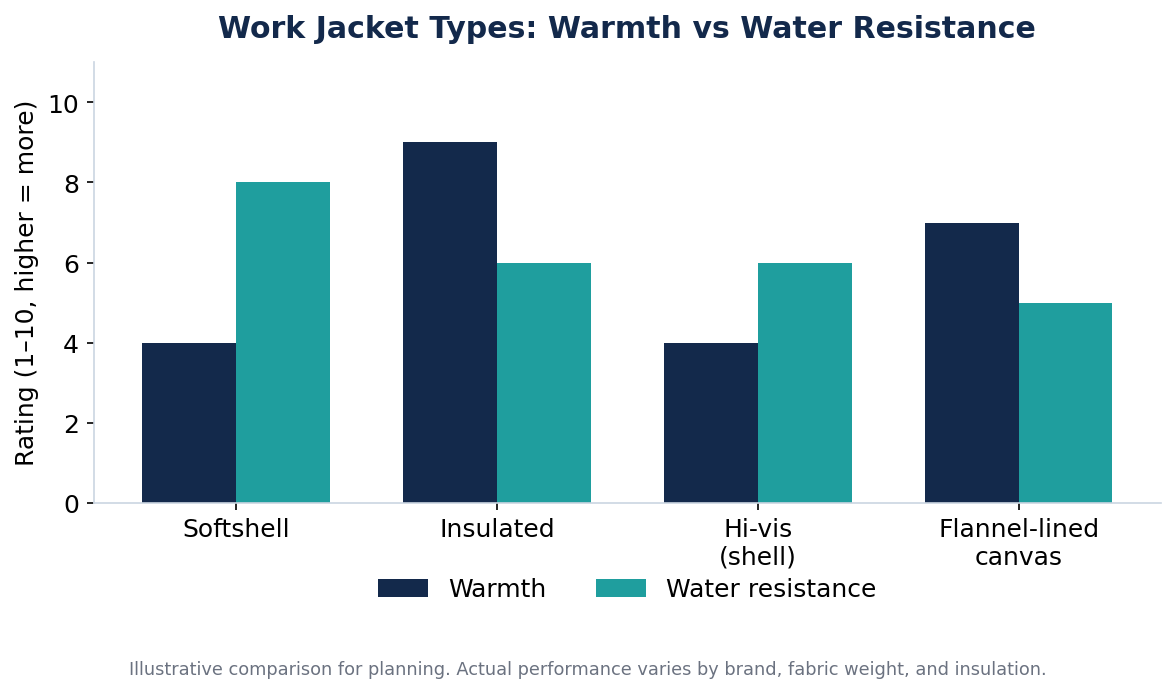
| Type | Warmth | Best for | Trade-off |
|---|---|---|---|
| Softshell | Low–medium | Mild/cool weather, active work, branding | Limited warmth in deep cold. |
| Insulated | High | Winter sites, cold storage, outdoor crews | Bulkier; can be warm indoors. |
| Hi-vis | Varies (shell or insulated) | Roadwork, traffic, warehouses | Must meet ANSI class for the job. |
| Flannel-lined canvas | Medium–high | Construction, ranch, heavy-duty work | Heavier, less stretch. |
If you only outfit a crew with one style, a softshell handles the widest range of mild days, while a job near traffic legally needs a hi-vis jacket regardless of comfort. You can compare these styles in our work jacket collection.
Hi-vis classes explained (ANSI/ISEA 107)
If your team works near vehicles or equipment, hi-vis isn’t optional and the class matters. The U.S. standard, ANSI/ISEA 107, sets three classes based on how much background and reflective material a garment has:
- Class 1 — lowest visibility; for low-traffic areas like parking lots, well away from moving vehicles.
- Class 2 — mid-level; the common requirement for roadway construction, surveying, and airport ground crews.
- Class 3 — highest visibility; required near high-speed traffic and for poor visibility or night work, with sleeves included.
Always confirm the class your site or contract requires before ordering, because a Class 2 jacket won’t satisfy a Class 3 requirement.
How to choose a work jacket by industry and weather
Three questions cover almost every decision: How cold does it get? Is hi-vis required? How rough is the work?
- Construction & trades: flannel-lined canvas or insulated for durability and warmth; add hi-vis where required.
- Roadwork, utilities, traffic: a hi-vis jacket in the correct ANSI class, insulated for winter.
- Landscaping, delivery, active crews: a softshell for breathable, water-resistant flexibility.
- Cold storage & winter outdoor work: a heavily insulated jacket, layered over a softshell if needed.
Pick your style, add hi-vis if you need it, and brand it with embroidery or print in our builder.
Get a QuoteReady to brand a batch for the company? See our companion guide to custom work jackets in bulk, or browse styles in the work jacket collection.
Frequently asked questions
What type of work jacket is warmest?
Insulated work jackets are the warmest, using synthetic fill or quilted lining built for cold sites. Flannel-lined canvas jackets are a close second and add abrasion resistance. Softshells are the least warm but the most breathable and flexible for active work.
What is the difference between a softshell and an insulated work jacket?
A softshell is a lightweight, stretchy, water-resistant jacket made for movement in mild weather. An insulated work jacket adds fill for serious warmth in cold conditions but is bulkier and less flexible. Many crews keep a softshell for shoulder seasons and an insulated jacket for winter.
What hi-vis class do I need?
It depends on your environment. Class 1 suits low-traffic areas, Class 2 is the common requirement for roadway and construction work, and Class 3 is required near high-speed traffic or for night and low-visibility work. Always confirm the class your site or contract specifies.
Can a work jacket be both warm and high-visibility?
Yes. Many hi-vis jackets are insulated or come as bomber and parka styles, so you get ANSI-rated visibility and cold-weather warmth in one garment. Just confirm it still meets the hi-vis class your job requires.
Safety requirements vary by job site, employer, and jurisdiction. Always confirm the required ANSI/ISEA hi-vis class for your work before ordering. Last reviewed: 2026.