Work Jacket Types Compared: Softshell, Insulated & Hi-Vis
Choosing among the different work jacket types on the market can feel harder than it should, mostly because catalog copy rarely explains what each style is actually built to do on the job. A softshell earns its keep on mild, active days when a crew is moving and needs to bend, reach, and climb. An insulated jacket earns its keep once temperatures drop and people spend more time standing still than moving. A hi-vis jacket earns its keep any time being seen matters as much as staying warm. Comparing these work jacket types side by side, instead of reading each spec sheet in isolation, is the fastest way to order the right jacket for every role on a team instead of one compromise jacket for everyone.
Why one jacket rarely covers a whole crew
Most crews end up owning at least two jacket styles once the swap-outs start happening in the field. A flagger standing at a lane closure for six hours has completely different needs than a framer climbing scaffolding, even if they clock in at the same yard at the same 6 a.m. start time. Buying a single “do everything” jacket usually means everyone is a little too warm on active days and a little too cold on stationary ones, and visibility gets treated as an afterthought rather than a built-in feature. Splitting the order across two or three types, sized to the actual roles on the crew, typically costs about the same per person once you are ordering in bulk, but it fits the work far better.
Softshell jackets: built for movement and mild weather
Softshell fabric is a bonded, stretch-woven material that blocks wind and light rain while staying breathable enough for constant motion. It is the go-to pick for spring and fall work, for indoor-outdoor roles like warehouse loading, and for any job where a stiff or bulky jacket would slow someone down. Most softshells rate around a 5 out of 10 for pure warmth on their own, but they layer well over a fleece or thermal shirt, which is usually a smarter system than buying one heavier shell.
Where softshell falls short
Softshell is not built for sustained rain or for standing around in cold wind. Water resistance is typically good enough to shrug off a light shower, but it is not a substitute for a true waterproof shell in a downpour, and without a liner it will not keep someone warm once they stop moving.
Insulated jackets: built for cold and standing still
Insulated work jackets add a synthetic or down-alternative fill, usually somewhere in the range of 60 to 200 grams per square meter depending on the climate they are built for. They are the right call for early-morning cold, walk-in coolers, outdoor security posts, and any winter role where a person is not generating much body heat through movement. The trade-off is bulk and breathability: a heavily insulated jacket that feels perfect at 6 a.m. can become uncomfortably warm by mid-morning once the sun is up and the crew is working hard.
Trade-offs of extra insulation
More fill means more warmth but less range of motion and slower drying if it gets wet. Crews that move between cold trucks and warm buildings all day often do better with a mid-weight insulated jacket and an adjustable base layer, rather than the heaviest option on the rack.
Hi-vis jackets: visibility comes first
Hi-vis jackets are built around ANSI/ISEA-style class ratings, using fluorescent fabric and reflective tape sized to keep a worker visible to traffic or equipment from a set distance. They come in softshell, insulated, and light-shell versions, so “hi-vis” really describes a visibility system layered onto one of the other base types rather than a warmth level of its own. Road crews, utility workers, and anyone working near moving vehicles or heavy equipment should treat a hi-vis rating as non-negotiable regardless of which underlying jacket type they choose.
Comparing the three types side by side
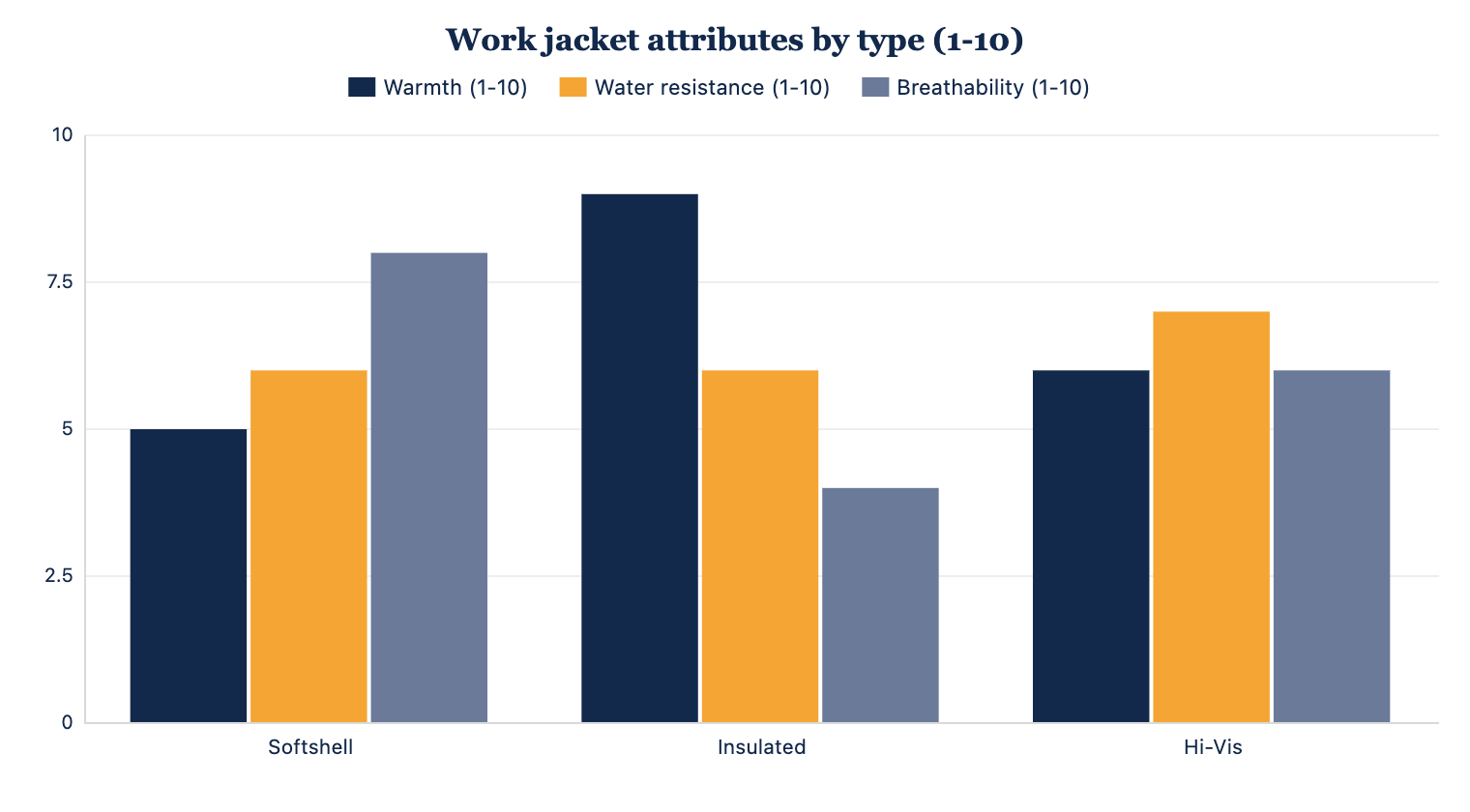
Laid out this way, the pattern is easy to see: softshell wins on breathability, insulated wins on warmth, and hi-vis sits in the middle because it is really a visibility layer added on top of one of the other two base types. Very few jackets score well on all three axes at once, which is exactly why matching the jacket to the role beats searching for a single “best” option.
How cold is too cold for each style
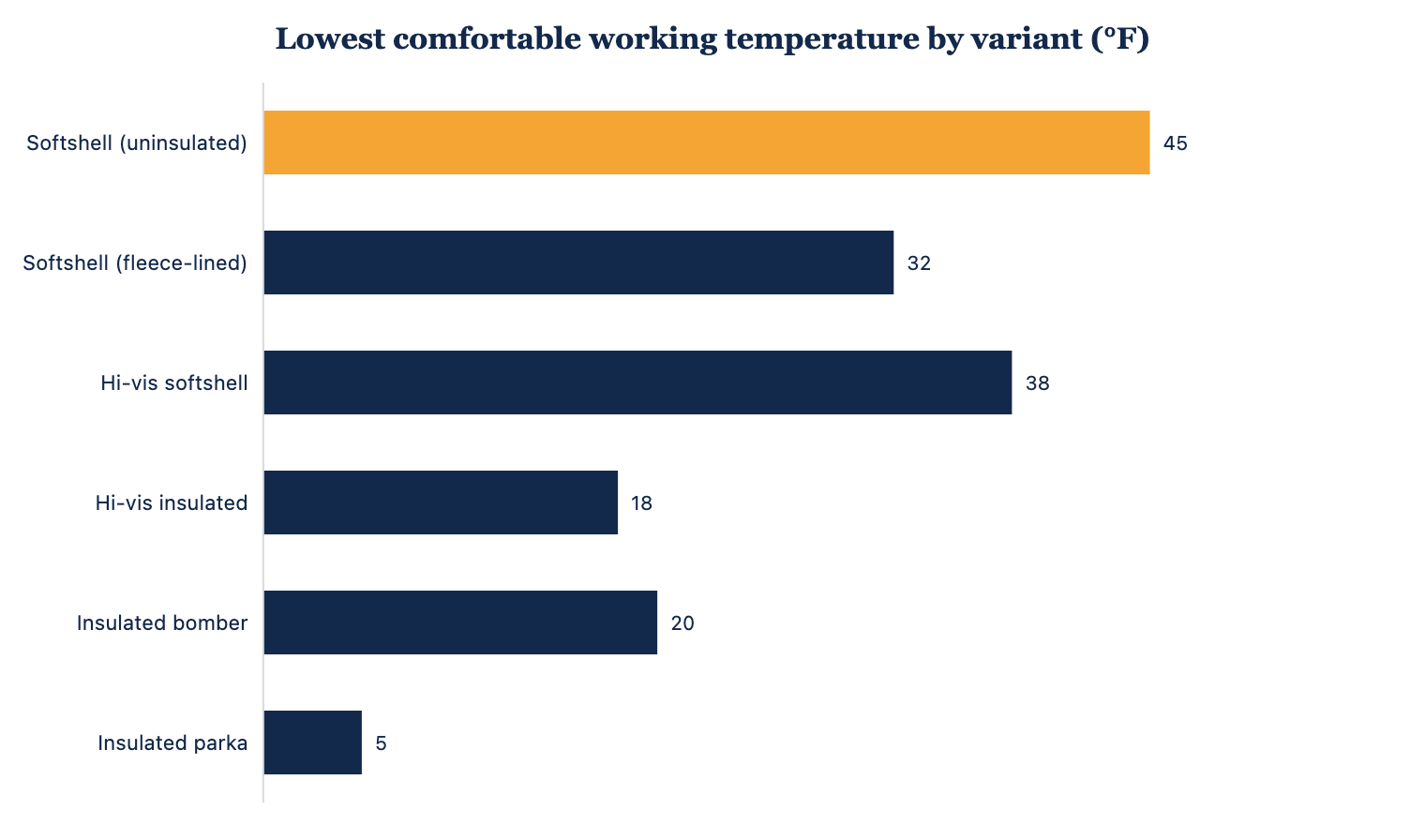
These numbers are typical comfort ranges for someone doing light to moderate activity, not hard limits, and they shift with wind, humidity, and how many layers a person adds underneath. An uninsulated softshell is a fair-weather jacket; a fleece-lined softshell buys another 10 to 15 degrees of comfort; and a true insulated parka is what most crews reach for once mornings dip toward freezing.
Layering strategy
Rather than buying the warmest possible jacket for winter, many crews do better layering a mid-weight insulated jacket over a moisture-wicking base and a light fleece. That combination adapts through a full shift, while a single maximum-warmth jacket often gets unzipped and left that way by mid-morning.
| Scenario | Best-fit jacket type | Why |
|---|---|---|
| Active outdoor work, mild season | Softshell | Breathable, flexible, blocks wind and light rain |
| Early morning cold, low activity | Insulated | Warmth without needing movement to stay comfortable |
| Roadside or equipment-adjacent work | Hi-vis (softshell or insulated) | Visibility rating is the deciding factor |
| Mixed indoor/outdoor shifts | Mid-weight insulated with removable liner | Adapts across temperature swings in one shift |
Matching jacket type to role, not just weather
The most efficient way to order for a mixed crew is to sort people by role first and weather second. Give the stationary flaggers and equipment operators the warmest, highest-visibility option. Give the climbers, framers, and anyone doing constant physical work a softshell they can move in. When you are comparing work jacket types for a whole roster rather than a single hire, ordering two or three tiers almost always beats forcing everyone into one jacket. Add your logo consistently across every type so the crew still reads as a unified team no matter which jacket each person is wearing that day.
Fit matters as much as fabric. A jacket that is too tight under a tool belt or too long around a ladder is a hazard as much as an annoyance, so measure for movement, not just chest size, before finalizing a bulk order. Learn more about how we handle bulk sizing and logo placement on our about page, or head back to the homepage to browse the full jacket lineup.
Get your crew outfitted the right way
Tell us your team size, roles, and climate and we will recommend the right mix of softshell, insulated, and hi-vis jackets with your logo.
Get a QuoteHome · About · Buying guides · Companion guide: landscaping work jackets