Custom Work Jackets for Construction Crews: Durability & Branding
Construction work jackets take more abuse than almost any garment your company will buy. They ride through concrete dust, rebar, welding sparks, freezing mornings, and repeated washing, all while carrying your logo in front of clients and the public. Getting them right means balancing two things at once: a shell tough enough for the job site and branding sharp enough to look professional. This guide covers the fabrics that survive real construction work, how to brand a crew so it reads as one team, and how bulk work jackets are priced so you can outfit everyone without blowing the budget. If you are speccing custom work jackets for a construction crew, start here.
What Makes a Good Construction Work Jacket?
The best construction work jackets are built around the shell fabric. Everything else, from insulation to hardware, hangs off that choice. A jacket that is too light tears and abrades within a season; one that is too heavy leaves crews overheated and unwilling to wear it. Match the fabric to the climate and the trade.
Canvas Duck: The Job-Site Standard
A canvas duck jacket is the classic choice for a reason. Cotton duck is a tight, heavy plain-weave cotton that resists abrasion, snags, and sparks far better than nylon or polyester shells. It softens as it breaks in, takes embroidery cleanly, and shrugs off the daily contact with rough materials that defines construction work. A 12-ounce duck shell with a blanket or quilted lining is the workhorse of framing, concrete, and general contracting crews across most of the year.
Insulated and Softshell Options
For deep-winter work, an insulated duck jacket adds quilted or synthetic fill without giving up the tough cotton shell. When crews need mobility and water resistance more than raw abrasion resistance, a softshell jacket delivers stretch, wind blocking, and a lighter feel for tasks like inspection, site management, or shoulder-season work. Many companies buy two styles and let crew pick by season.
Hi-Vis Construction Jacket Requirements
Any crew working near traffic, heavy equipment, or on roadways needs a hi-vis construction jacket that meets ANSI/ISEA 107 visibility standards. These jackets combine fluorescent shell fabric with reflective tape and are rated by class, with Class 3 offering the most coverage for high-speed or low-light environments. The good news is that hi-vis shells still take embroidery and heat-transfer branding, so safety and identity live on the same garment.
Fabric Weight and Warmth: Comparing Jacket Types
Shell weight is the fastest proxy for durability. Heavier fabric generally means a tougher, longer-lasting jacket, though it also means more warmth and less breathability. The chart below compares typical shell fabric weight across the four styles construction crews order most.
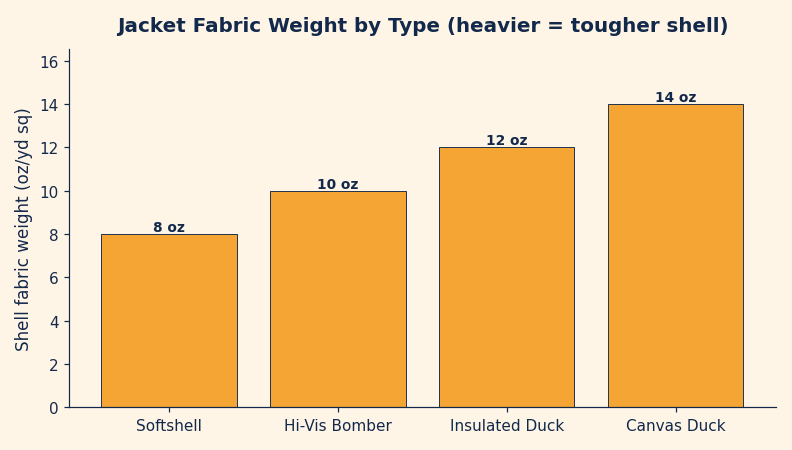
Softshells sit lightest and most breathable, hi-vis bombers land in the middle, and duck shells, especially heavyweight canvas duck, are the toughest and longest-wearing. As a rule, choose the heaviest fabric your crew will comfortably wear for the conditions they face: a 12 to 14 ounce duck shell for hard trades and cold sites, a lighter softshell for site supervisors and warmer seasons. Do not forget the lining. A blanket-lined or quilted duck jacket adds real warmth without changing the shell, while an unlined chore-style duck jacket works for spring and fall layering. Matching the shell and lining to your actual work window is what keeps jackets on backs instead of in trucks.
Crew Uniform Branding That Looks Professional
A branded crew signals competence before anyone says a word. Consistent construction work jackets tell clients you run an organized operation and make your people easy to spot on a busy site. It also doubles as low-cost advertising: a crew of branded jackets moving around a visible job site puts your company name in front of neighbors and potential customers every single day. Effective crew uniform branding usually combines a few elements.
| Element | Placement | Why |
|---|---|---|
| Company logo | Embroidered left chest | Durable, professional, client-facing |
| Company name / trade | Large back print | Visible across the job site |
| Employee name | Right chest patch | Personal, and reusable with hook-and-loop |
| Phone / website | Back or sleeve | Turns every jacket into a billboard |
For a full breakdown of the trade-offs between decoration methods on outerwear, see our guide to work jacket decoration: embroidery vs patches vs screen print. For construction crews, the reliable default is an embroidered chest logo for durability plus a screen-printed back for visibility.
Bulk Work Jackets: How Pricing Works
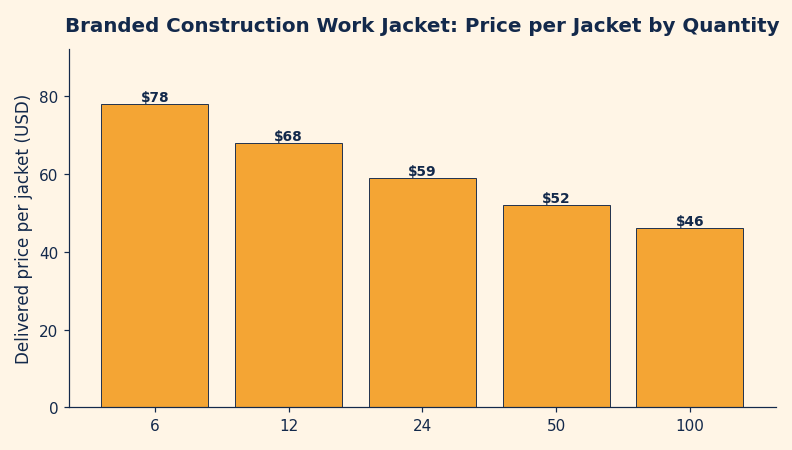
The biggest lever on cost is quantity. Blank jacket cost, decoration setup, and shipping all spread across more pieces as your order grows, so bulk work jackets get meaningfully cheaper per unit at every tier. The first chart above shows the pattern for a branded canvas duck construction jacket: a six-piece order lands near the top of the range, while a hundred-piece order can cost roughly forty percent less per jacket.
A few practical notes on ordering in volume:
- Consolidate your order. One order of 50 beats five orders of 10 on both price and consistency, since every jacket comes from the same dye lot and decoration run.
- Order a size range with overage. Build in a few extra jackets in common sizes for new hires and replacements; adding one or two later costs far more per piece.
- Lock the spec in writing. Fabric weight, color, lining, decoration locations, and sizing should all be confirmed on a proof before production starts.
- Plan the timeline. Custom decorated jackets need time for proofing and production; order well ahead of the cold season when demand spikes.
If you are comparing suppliers, browse the rest of our work jacket resources or learn how we support company orders on our about page. You can also reach our team directly through the contact page to talk through your crew’s needs.
Frequently Asked Questions
What is the best fabric for a construction work jacket?
For most trades, a 12-ounce cotton canvas duck shell is the sweet spot: it resists abrasion and sparks, breaks in comfortably, and takes embroidery cleanly. Add a quilted or blanket lining for cold climates, or step down to a softshell when mobility and breathability matter more than raw toughness.
How many jackets do I need to order to get bulk pricing?
Price improves at every tier, but the biggest per-jacket savings tend to kick in around 24 to 50 pieces, where blank cost and decoration setup spread across enough units to matter. Even a 12-piece crew order beats buying jackets individually.
Can hi-vis construction jackets be branded?
Yes. ANSI-rated hi-vis shells accept embroidery and heat-transfer decoration without compromising their rating, as long as branding is kept off the reflective tape. That lets you meet visibility requirements and carry your logo on the same jacket.
How far ahead should I order for winter?
Order before the cold-season rush. Custom decorated jackets need time for proofing and production, and demand spikes in fall, so placing your order several weeks ahead avoids rush fees and stockouts on popular sizes and colors.
Putting It Together for Your Crew
Great construction work jackets come down to three decisions: pick a shell fabric tough enough for the trade and climate, brand it consistently so the crew reads as one team, and order in enough volume to earn the best per-jacket price. Get those right and you end up with jackets your crew actually wants to wear, that survive multiple seasons, and that put your company name in front of every client and passerby on the job site.
Outfit Your Whole Crew
Send us your headcount, sizes, and logo and we’ll return tiered bulk pricing on canvas duck, insulated, and hi-vis construction work jackets with a free digital proof.
Get a Quote