Insulated vs Softshell Work Jackets: A Winter Crew Guide
When temperatures drop, the jacket you put your crew in affects both comfort and productivity — and the first decision is insulated versus softshell. Insulated work jackets trap warmth for cold, low-movement work; softshells favor mobility and breathability for active crews in milder cold. This guide compares the two so you can outfit your crew for the conditions they actually work in.
There is no single best answer — the right pick depends on temperature and how much your crew moves. Many operations carry both and issue by season.
Insulated vs softshell: the trade-offs
Insulated jackets win on warmth but sacrifice mobility and breathability; softshells win on movement and breathability but offer less raw warmth. The scores below summarize the comparison for custom work jackets.
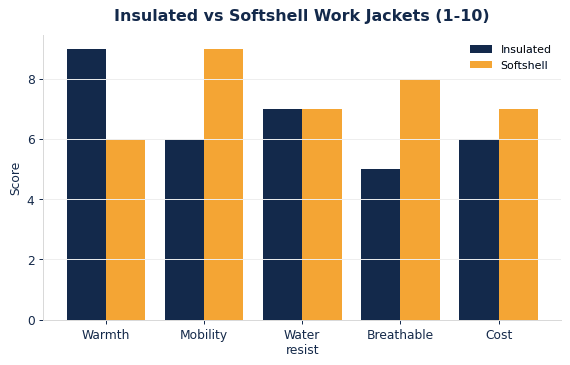
For crews that generate body heat through movement, an overly warm insulated jacket can cause overheating and sweat — which then chills them. Match the jacket to the workload, not just the thermometer.
Choosing by working temperature
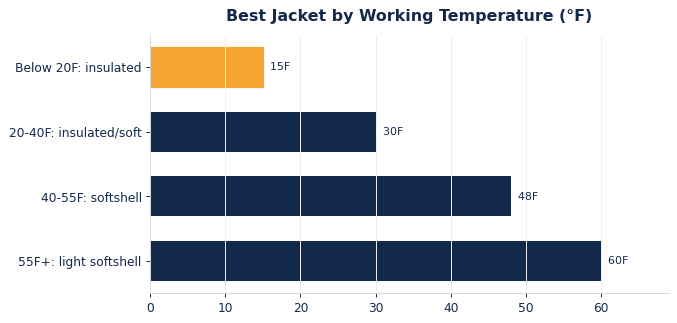
As a rule of thumb, reach for insulated below about 40°F, a softshell in the 40–55°F range, and a light softshell above that. The guide below maps jacket type to working temperature.
Branding and durability
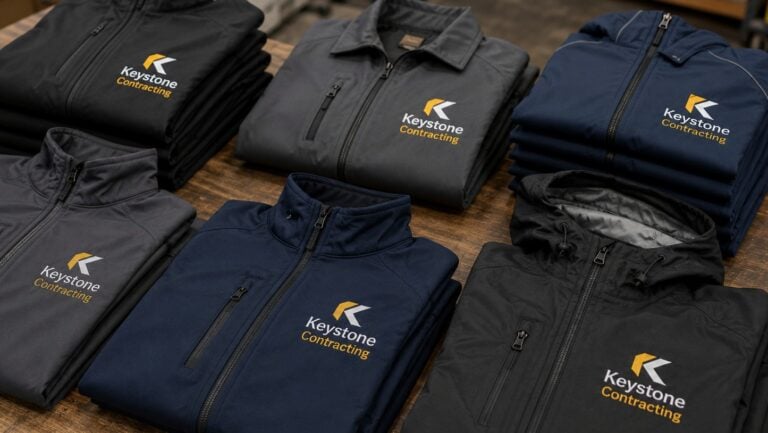
Both jacket types take embroidery well for a durable, professional logo; heavier insulated shells also suit back patches. Choose reinforced seams and abrasion-resistant fabric for trades that are hard on gear, and confirm the decoration area before ordering.
| Temp | Pick | Note |
|---|---|---|
| Below 40F | Insulated | Cold, low movement |
| 40-55F | Softshell | Active crews |
| 55F+ | Light softshell | Layer piece |
Working outdoors near traffic? See our companion guide, our Hi-Vis Work Jackets: ANSI-Rated Custom Options for Crews. Explore our custom work jackets or request a quote.
Insulation types and what they mean for warmth
Not all insulated work jackets keep warmth the same way, and knowing the type helps you match the jacket to the cold. Traditional poly-fill and down offer excellent warmth for their weight but lose insulating power when wet, while synthetic insulations keep warming even when damp, which matters for crews working in snow or rain. Some modern jackets use a thin, high-loft synthetic that delivers real warmth without the bulk that restricts movement, bridging the gap toward softshell mobility.
Softshells, by contrast, rely on a dense, wind-resistant woven fabric and often a light fleece backing for warmth rather than loft. That construction breathes better and moves with the body, which is why active crews prefer it, but it tops out at a lower temperature than a proper insulated shell. Understanding these mechanisms lets you predict how a jacket will actually perform on your site rather than guessing from a label.
Layering systems for variable days
A single jacket rarely covers a workday that starts near freezing and warms into the afternoon, which is where a layering system beats one heavy shell. A softshell worn over a fleece or mid-layer adapts as conditions change: shed the mid-layer as it warms, add it back when the wind picks up. This flexibility keeps crews comfortable and productive without hauling multiple bulky coats, and it lets one jacket program serve a wider temperature range.
Building a layering approach also affects what you order. A softshell that fits comfortably over a mid-layer, plus a warm insulated option for the coldest days, covers most conditions a crew faces. Speccing jackets with layering in mind — a little room in the softshell, a windproof outer face — turns a wardrobe of coats into a coordinated system that works across the season.
Branding, durability, and jobsite realities
Both insulated and softshell jackets take branding well, but the method and placement should suit the fabric and the work. Embroidery gives a durable, professional logo on both types and suits chest and sleeve placements, while a larger back logo or patch works on the flat panels of a heavier insulated shell. For trades hard on gear, reinforced seams, abrasion-resistant fabric, and quality zippers keep a branded jacket looking sharp rather than tired after a month on site.
Durability protects your branding investment. A jacket that holds up to daily wear keeps your logo visible and your crew looking professional across a full season and beyond, so spending on construction quality pays back over the life of the garment. Confirming the decoration area and fabric durability before a large order ensures the jackets perform as both workwear and walking advertisements.
Sizing and ordering for a whole crew
Outfitting a crew is easier when you plan sizing and quantities up front. Work jackets are worn over layers, so a fit that accommodates a mid-layer without being baggy is the goal, and offering a sensible size run from small through the larger sizes keeps every crew member comfortable. Collecting sizes before ordering, rather than guessing, avoids the frustration of jackets that do not fit and the cost of exchanges once a run is decorated.
Ordering in volume also improves the economics. Per-jacket cost drops as quantity rises, so kitting out a full crew or multiple sites at once is more efficient than piecemeal buys, and it keeps everyone in the same on-brand jacket. Ordering a few spares covers new hires and replacements so a latecomer is not left without the crew’s gear.
Lead time matters for seasonal workwear. Because embroidery and decoration add production time, ordering ahead of the cold season ensures jackets arrive before crews need them rather than mid-winter. Building in that buffer, and keeping the approved artwork and size run on file, turns next season’s reorder into a simple repeat.
Common questions about work jackets
Insulated or softshell for winter crews?
Choose insulated for cold, low-movement work below about 40 degrees, and softshell for active crews in the 40 to 55 degree range where mobility and breathability matter. Match the jacket to the workload, not just the thermometer, since active crews can overheat in a heavy insulated shell.
Can one jacket cover a wide temperature range?
A layering system does this better than a single heavy coat. A softshell over a fleece adapts to a warming afternoon, while a separate insulated option covers the coldest days. Speccing the softshell with a little room for a mid-layer makes the system work.
Does insulation still work when wet?
Synthetic insulations keep warming even when damp, while down and some poly-fills lose loft and warmth when wet. For crews in snow or rain, a synthetic-insulated or water-resistant shell is the safer choice.
What is the best way to brand a work jacket?
Embroidery gives a durable, professional logo on both jacket types and suits chest and sleeve placements, while a larger back logo or patch works on the flat panels of a heavier insulated shell. Confirm the decoration area and choose durable fabric so branding lasts through a full season of daily wear and washing.
When should I order jackets for winter?
Order ahead of the cold season, since embroidery and decoration add production time and you want jackets in hand before crews need them, not mid-winter. Collecting sizes in advance and keeping the artwork on file makes each season’s reorder a simple repeat.
Outfitting your crew for winter?
We’ll match jacket type, durability, and branding to your crew’s conditions.
Get a Quote