Landscaping Work Jackets: Custom Gear for Lawn Care Crews
Anyone who runs a landscaping or lawn care crew already knows the job moves through four completely different kinds of weather in a single year, which is exactly why generic outerwear rarely survives a full season. Landscaping work jackets need to handle dew-soaked spring mornings, bright hot afternoons, a fall push of leaf cleanups, and the first cold snaps of plowing season, sometimes within the same week. Picking landscaping work jackets built around how a crew actually moves — bending over beds, pushing mowers, climbing in and out of trucks — matters more than chasing the highest warmth rating on the tag.
Why landscaping gear has to work across every season
Unlike an indoor trade, landscaping and lawn care crews are outside for the entire shift, every day of the growing season and well into the shoulder months. That means outerwear has to flex across a wider temperature range than almost any other trade, often swinging 30 or more degrees between a 6 a.m. start and a 2 p.m. finish. A jacket that only works in one narrow band of weather gets left in the truck half the year, which is money spent on gear nobody wears.
Spring cleanups: wet, cool, and constantly moving
Spring crews spend long stretches bent over beds, raking wet debris, and hauling loaded tarps, so a jacket needs to shed light rain and dew without trapping heat during heavy exertion. A softshell with decent water resistance and full range of motion in the shoulders is usually the right call here, since crews are moving hard enough to generate their own warmth even when the air is still cool.
Summer mornings: light layers before the heat sets in
Many crews start summer routes before sunrise specifically to beat the heat, which means the first hour or two is cool enough for a light jacket even though the forecast says 90 by noon. A breathable, packable layer that stuffs into a truck cab once the sun is up matters more than warmth here — bulk is the enemy on a summer route.
Fall leaf season: the heaviest volume of the year
Fall is typically the busiest stretch for a landscaping business, with leaf removal, mulching, and bed cleanups stacked back to back. Crews are working longer days in falling temperatures, so this is where a mid-weight jacket with real pocket capacity for tools, phone, and gloves earns its keep. Hi-vis becomes more important here too, since shorter daylight hours push more work into low-light morning and evening conditions.
Winter prep and plowing: standing cold, not moving cold
Once snow and ice work start, crews spend more time standing and directing equipment than they do raking or mowing, so warmth becomes the priority again, closer to the insulated end of the spectrum. Visibility matters more in winter conditions too, with low light, snow glare, and plow trucks moving through the same lot as ground crews.
Durability: what mud, sap, and gas actually do to a jacket
Landscaping is harder on outerwear than most trades because the damage is chemical as much as physical. Pine sap gums up zippers and seams, fresh-cut grass stains show on light fabric, and splashed gas or two-stroke oil near trimmers and blowers can degrade cheap coatings over a season. Ripstop or abrasion-resistant softshell fabric, reinforced elbows, and a treated water-resistant coating hold up far better under weekly abuse than a basic shell jacket. Zipper quality matters too, since a jammed zipper on a cold morning is the kind of small failure that slows down an entire crew.
Washing without ruining the coating
Crews that machine-wash jackets weekly should skip fabric softener, which breaks down water-repellent coatings over time, and air dry rather than tumble dry on high heat. A jacket that loses its water resistance by August is a jacket that gets replaced mid-season, which is the exact cost a durable fabric choice is meant to avoid.
Where crews spend their season
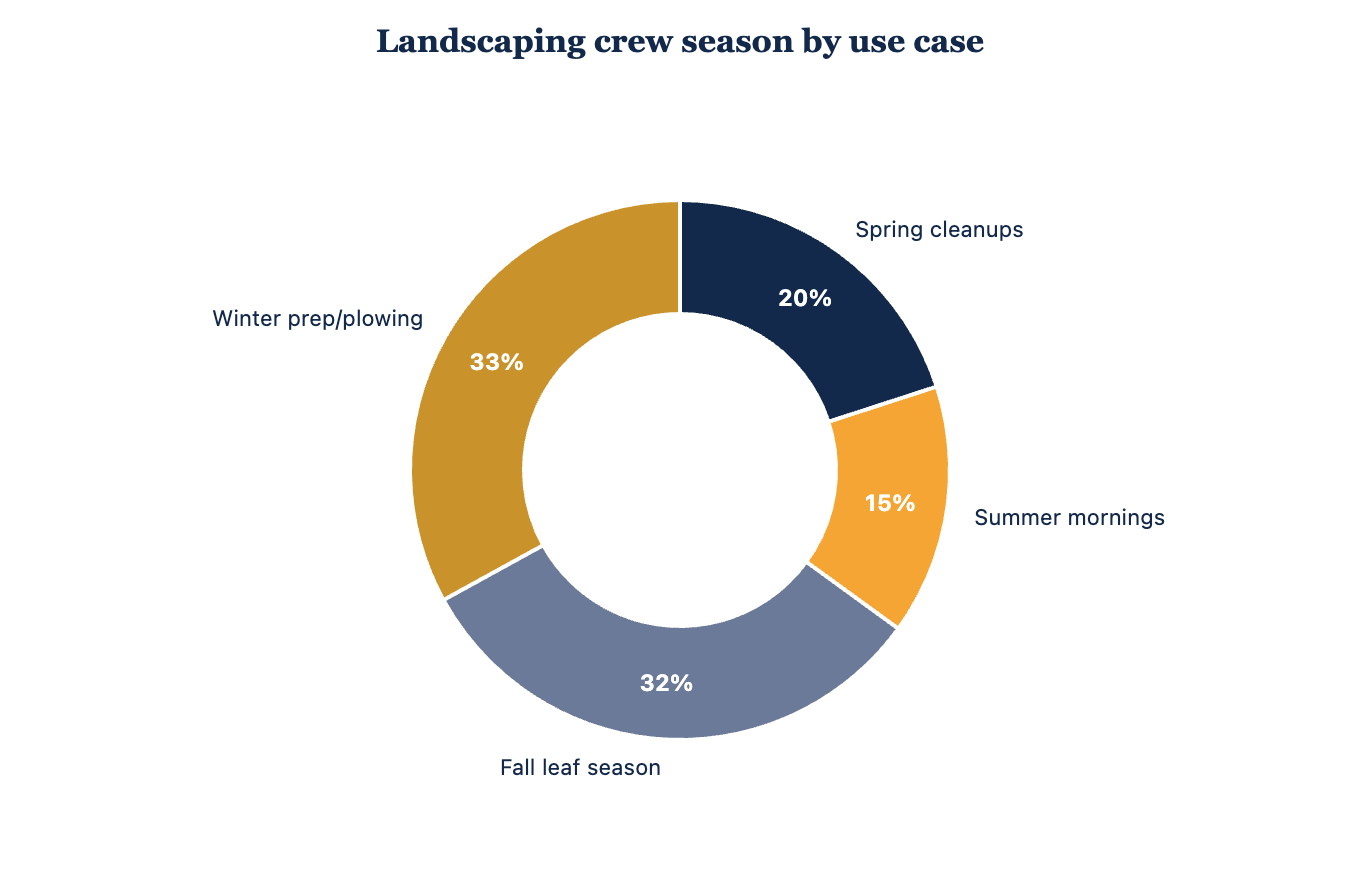
Fall leaf season and winter prep together account for roughly two-thirds of the annual outdoor grind for a lot of crews, which is why so many landscaping businesses standardize on a mid-weight jacket for the bulk of the year and add a lighter softshell just for spring and summer routes.
What landscaping crews actually prioritize in a jacket
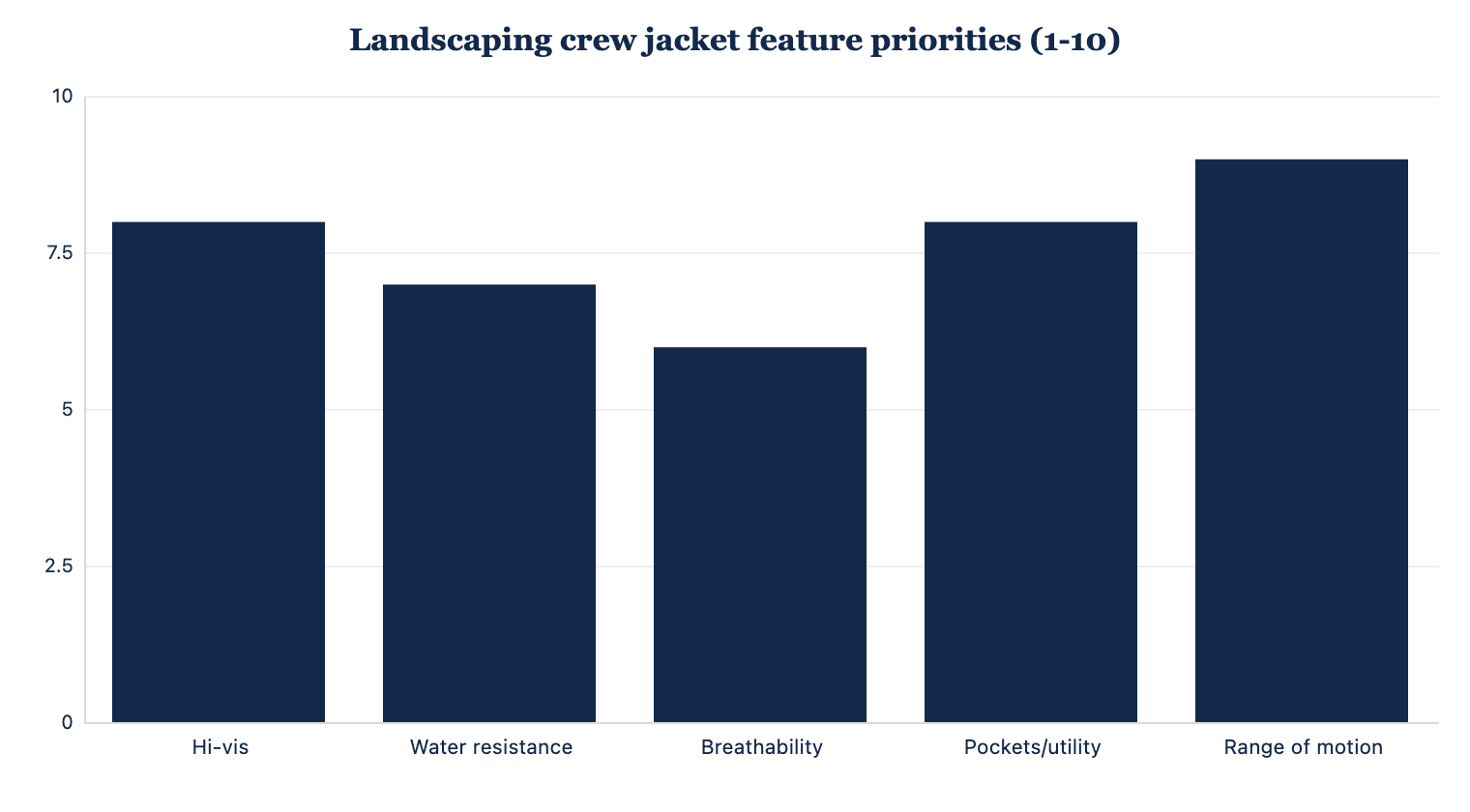
Range of motion and hi-vis consistently rank at the top for crews that work near mowers, trimmers, and roadside beds, ahead of raw warmth. Pockets and utility features matter more than people expect too — a jacket with a secure phone pocket and a spot for pruners or gloves saves constant trips back to the truck.
| Season | Recommended jacket | Priority feature |
|---|---|---|
| Spring cleanups | Lightweight softshell | Water resistance, range of motion |
| Summer mornings | Packable light layer | Breathability, low bulk |
| Fall leaf season | Mid-weight hi-vis softshell | Pockets, visibility |
| Winter prep/plowing | Insulated hi-vis jacket | Warmth, visibility |
Branding gear that survives a full season
Landscaping crews are outdoors in front of customers constantly, which makes a jacket one of the most visible pieces of marketing a business owns. Embroidered logos hold up far better than heat-transfer prints once a jacket goes through weekly mud, sap, and repeated washing, and a consistent look across the crew reads as more established to homeowners answering the door. Ordering landscaping work jackets in a size range that fits your actual roster, rather than a generic S-XL spread, cuts down on returns and keeps the whole team looking uniform.
Placement matters as much as the logo itself. A chest emblem stays visible when a jacket is half-zipped in warm weather, while a back panel reads best from a distance on a roadside crew. Keep colors limited to two or three so embroidery costs stay reasonable at bulk quantities, and confirm your hi-vis pieces still meet visibility requirements once a logo panel is added.
Start by outfitting your core crew with one mid-weight, hi-vis-capable jacket for fall and winter, then add lighter softshells for spring and summer once budget allows. Crews with a wide age and size range also do better ordering a broader run of sizes up front, since exchanging a single jacket mid-season costs more in downtime than ordering an extra size or two at the start. Visit our homepage to browse current styles, or read more about how we handle bulk crew orders on our about page.
Outfit your landscaping crew for every season
Tell us your crew size and the seasons you work hardest, and we will recommend the right jacket mix with your logo.
Get a QuoteHome · About · Buying guides · Companion guide: work jacket types compared